Regenerative agriculture carbon credits are becoming an important consideration for agricultural and livestock businesses seeking to improve soil health, reduce greenhouse-gas emissions and create additional value from their operations.
Sustainability in agriculture is increasingly about more than environmental responsibility. Better land management, improved resource utilization and more efficient production systems can also support the long-term economic performance of agricultural projects.
At Cantek Meat Systems, we continuously evaluate how sustainability developments can be incorporated into the livestock, agricultural and agro-industrial projects we develop with our clients.
Our objective is straightforward: when better use of land, energy, water or agricultural resources can create additional value for a project, we want to help identify and evaluate that opportunity.
What Is Regenerative Agriculture?
Regenerative agriculture refers to farming and livestock-management practices designed to improve the long-term health and productivity of agricultural ecosystems.
Instead of considering production output alone, regenerative approaches can also focus on soil health, water efficiency, nutrient cycles, biodiversity and the responsible use of natural resources.
Depending on the characteristics of a project, regenerative practices may include:
- Improved grazing and pasture management
- Crop rotation
- Cover crops
- Reduced soil disturbance
- Improved fertilizer management
- Agricultural residue utilization
- Improved manure management
- Integration between livestock and crop production
- Practices designed to increase soil organic carbon
For livestock projects in particular, grazing systems and pasture management can have a significant influence on how efficiently agricultural land is utilized.
These practices can provide environmental and operational benefits even without participation in a carbon market. Under suitable conditions, however, some regenerative practices may also contribute to measurable greenhouse-gas emission reductions or carbon removals.
This is where carbon credits may become relevant.
How Regenerative Agriculture Carbon Credits Are Generated
Carbon credits can provide an economic mechanism for certain verified greenhouse-gas reductions or removals.
In agricultural projects, this may occur when a change in land or livestock management produces a measurable climate benefit compared with an established baseline.
For example, improved soil management may increase the amount of carbon stored in agricultural soil. Better fertilizer practices may reduce emissions associated with agricultural inputs. Improved grazing strategies may contribute to healthier pastures and increased soil organic carbon.
Recognized methodologies already exist for assessing some of these practices. For example, Verra’s Improved Agricultural Land Management methodology covers areas including grazing practices, fertilizer management, crop management, residue management and soil-carbon improvements.
However, introducing a regenerative practice does not automatically create carbon credits.
A simplified process may look like this:
Existing project conditions → regenerative measures → measurement and monitoring → quantified greenhouse-gas reduction or carbon removal → independent verification → potential carbon-credit issuance
Each project must therefore be assessed according to its individual conditions and the requirements of the applicable carbon standard or methodology.
Which Practices May Create Carbon Value?
The potential for carbon-credit generation can vary significantly between projects. Nevertheless, several areas can be particularly relevant to integrated agricultural and livestock operations.
Improved Grazing and Pasture Management
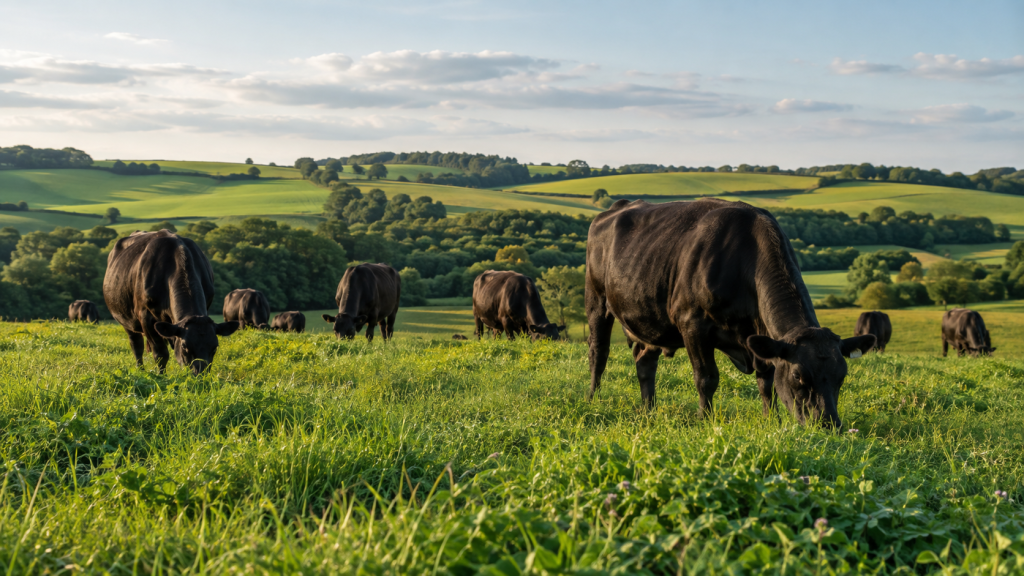
Grazing intensity, livestock movement and pasture recovery periods can influence soil condition, vegetation and long-term pasture productivity.
Depending on the project, location and applicable methodology, improved grazing management may contribute to increased soil-carbon storage.
For Cantek clients developing livestock-related investments, this means the agricultural land surrounding or supplying a project may deserve consideration alongside the processing facility itself.
Soil Management
Healthy agricultural soil is an important long-term resource.
Practices designed to reduce unnecessary soil disturbance, improve organic matter and maintain productive soil conditions may contribute to increased soil organic carbon.
The effectiveness of these practices depends on factors such as climate, soil type, historical land use and existing agricultural practices.
The Gold Standard Soil Organic Carbon Framework is one example of an established framework addressing the measurement of greenhouse-gas emissions and soil-carbon changes associated with improved agricultural practices.
Crop and Livestock Integration
Integrated agricultural projects can create opportunities to use resources more efficiently.
Crop residues may have value within livestock systems, while livestock-generated organic materials can potentially be returned to agricultural production where technically and environmentally appropriate.
This type of circular resource management can reduce waste and improve the overall efficiency of an agricultural operation.
It also aligns with Cantek’s wider approach to responsible and resource-efficient project development.
Manure and Organic Resource Management
Livestock operations generate significant quantities of organic material.
Rather than treating every organic stream purely as waste, projects can evaluate whether certain materials can be recovered, treated or transformed into useful resources.
Depending on project conditions, this may include fertilizer production, organic-resource recovery or biogas and energy-recovery applications.
Cantek already integrates these principles into its approach to waste management solutions, where resource recovery and by-product utilization can form part of the overall project strategy.
Carbon Credits Are Not Automatic
Carbon credits should not be treated as a guaranteed financial return from regenerative agriculture.
Every project is different.
Several factors can determine whether a project has realistic carbon-credit potential, including:
- Existing land-management practices
- Historical project conditions
- The regenerative practices being introduced
- Project location and climate
- Measurable greenhouse-gas impact
- Available carbon methodologies
- Monitoring requirements
- Project scale
- Baseline conditions
- Additionality requirements
- Validation and verification requirements
- Implementation and certification costs
This is why measurement, reporting and independent verification are important parts of credible carbon projects.
Specialized carbon-market professionals may be required to establish baselines, quantify greenhouse-gas reductions or removals, implement monitoring programs and complete the necessary validation or verification procedures.
Cantek does not replace these specialized certification bodies.
Our role is different.
How Cantek Meat Systems Can Help
Cantek Meat Systems works with clients across livestock production, slaughterhouse development, meat processing and wider agro-industrial investments.
Because we approach projects as integrated systems rather than isolated pieces of equipment, sustainability opportunities can be considered as part of the wider investment.
During business investment planning, we can evaluate how factors such as capacity, land use, utility requirements, production processes and resource flows interact.
From a regenerative and carbon-management perspective, this may involve examining:
- Livestock production
- Agricultural land
- Grazing systems
- Crop production
- Manure generation
- Organic waste
- Water utilization
- Energy consumption
- Agricultural by-products
- Resource-recovery opportunities
If an opportunity appears technically relevant, the next step can be to determine whether it warrants detailed assessment by qualified carbon-market specialists.
Where measurement, validation, verification or certification is required, the relevant specialists can then be integrated into the project.
Our role is to help connect the opportunity with the project.
This approach also fits naturally within Cantek’s turnkey project philosophy, where different technical and operational components are considered together rather than independently.
Can Existing Livestock Projects Have Carbon-Credit Potential?
Potential opportunities are not limited to new investments.
An existing livestock farm, agricultural operation or agro-industrial project may already contain areas where better land management, improved resource recovery or greenhouse-gas reduction measures could be introduced.
The first step is understanding the project as a complete system.
Land availability, livestock numbers, grazing practices, crop production, manure generation, waste streams, energy consumption and water requirements can all influence which sustainability measures may be technically and economically realistic.
For an existing Cantek project, these areas can be reviewed alongside the wider operation.
For a new investment, they can be considered earlier during project planning, when there may be greater flexibility to integrate the necessary infrastructure or operational strategy.
For livestock investors, regenerative agriculture carbon credits should therefore be considered as a potential additional value stream rather than a guaranteed financial return.
Creating More Value From Agricultural Projects
Agricultural and livestock projects increasingly need to balance productivity with resource efficiency and long-term environmental performance.
Regenerative agriculture offers one way to approach these objectives.
Carbon markets may add another dimension by assigning economic value to certain measurable and verified greenhouse-gas reductions or removals.
But the opportunity will not be suitable for every project.
The important step is determining whether that potential exists before it is overlooked.
At Cantek Meat Systems, we believe sustainability should be evaluated alongside engineering, production efficiency and overall project economics.
If you already have an ongoing project with Cantek Meat Systems, or you are considering a new livestock, agricultural or agro-industrial investment, we can evaluate whether regenerative practices and potential regenerative agriculture carbon credits could add another dimension of value to your project.
Your project may already contain opportunities that have not yet been explored. Let us help you identify them.